
You’ve heard it your whole life: invest your money. But when you actually try to start, the world of stocks, bonds, ETFs, and brokerage accounts can feel overwhelming — especially if no one ever taught you how. Here’s the truth: you don’t need a finance degree, a financial advisor, or a lot of money to start investing. What you need is a basic understanding of the options available to you and the courage to take your first step. This guide breaks it all down in plain English so you can start growing your money today, regardless of your budget.
Why Investing Matters — And Why You Should Start Now
Saving money in a bank account is safe, but it won’t make you wealthy. High-yield savings accounts currently offer around 4–5% APY — but historically they’re closer to 1–2%. The stock market, on the other hand, has returned an average of about 10% annually over the long run. That difference, compounded over decades, is staggering.
The Power of Compound Growth
Compound growth means your returns generate their own returns. Start with $1,000 and add $200 per month at a 7% average annual return. In 30 years, you’d have over $243,000 — even though you only contributed $73,000 out of pocket. That extra $170,000 is pure compound growth. The longer your money stays invested, the more powerful compounding becomes.
Why Time in the Market Beats Timing the Market
Many beginners wait for the “right time” to invest. But research consistently shows that time in the market — how long you stay invested — matters far more than market timing. Missing even the 10 best trading days in a decade can cut your returns nearly in half. The best strategy is simply to start and stay consistent, regardless of market conditions.
Inflation Is Silently Eroding Your Savings
Every year that your money sits in a low-interest account, inflation eats away at its purchasing power. If inflation averages 3% and your savings account earns 1%, you’re effectively losing 2% per year in real value. Investing is how you stay ahead of inflation and grow your wealth in real terms over time.
Investment Options for Beginners
You don’t need to pick individual stocks or understand complex derivatives to invest successfully. Most beginners do best with simple, diversified instruments.
Index Funds
An index fund tracks a market index — like the S&P 500, which represents the 500 largest U.S. companies. When you invest in an S&P 500 index fund, you own a small piece of all 500 companies. Index funds offer:
- Instant diversification across hundreds of companies
- Very low fees (expense ratios often below 0.05%)
- Historically strong returns that beat most actively managed funds
Index funds are available through nearly every brokerage and are widely recommended by financial experts including Warren Buffett.
ETFs (Exchange-Traded Funds)
ETFs are similar to index funds but trade on stock exchanges throughout the day like individual stocks. They offer the same diversification benefits with added flexibility. Many ETFs have no minimum investment and can be bought for the price of a single share — sometimes as low as $10–$50. Popular ETFs for beginners include VOO (S&P 500), VTI (total U.S. stock market), and SCHD (dividend-focused).
Target-Date Retirement Funds
If you want a set-it-and-forget-it option, target-date funds are ideal. You choose a fund based on your expected retirement year (e.g., “Target 2055 Fund”), and the fund automatically adjusts its asset allocation — more aggressive when you’re young, more conservative as you approach retirement. They’re perfect for beginners who don’t want to manage their portfolio actively.
Individual Stocks
Buying individual company stocks carries more risk but can be rewarding for those willing to research companies. As a beginner, it’s wise to limit individual stocks to a small portion (10–20%) of your portfolio. Stick to companies you understand, with strong financial histories, and avoid making emotional decisions based on market volatility.
How to Open Your First Investment Account
Getting started is easier than most people think. Here’s a simple step-by-step path to opening your first account.
Choose the Right Account Type
Before choosing a brokerage, decide what type of account you need:
- 401(k): Employer-sponsored retirement account; contribute via payroll. Always contribute enough to get the full employer match first.
- Traditional IRA: Individual retirement account with tax-deductible contributions; taxes paid on withdrawal
- Roth IRA: Contributions made with after-tax dollars; withdrawals in retirement are tax-free. Ideal for younger investors in lower tax brackets.
- Taxable brokerage account: No contribution limits or restrictions; best for saving beyond retirement accounts
Select a Beginner-Friendly Brokerage
Top options for new investors include Fidelity, Vanguard, Charles Schwab, and M1 Finance. All offer $0 account minimums, commission-free trades, and excellent educational resources. Avoid platforms that gamify trading or push complex options products — stick to straightforward, reputable brokerages.
Fund Your Account and Make Your First Purchase
Link your bank account, transfer funds, and place your first trade. Start with a broad index fund or ETF and automate monthly contributions. Most brokerages allow you to set up recurring investments — making it effortless to stay consistent. Even $25 or $50 per month is a meaningful start.
Beginner Strategies That Actually Work
The right strategy for a beginner is one that’s simple, consistent, and emotionally manageable. Here are the principles that have the strongest track record.
Dollar-Cost Averaging
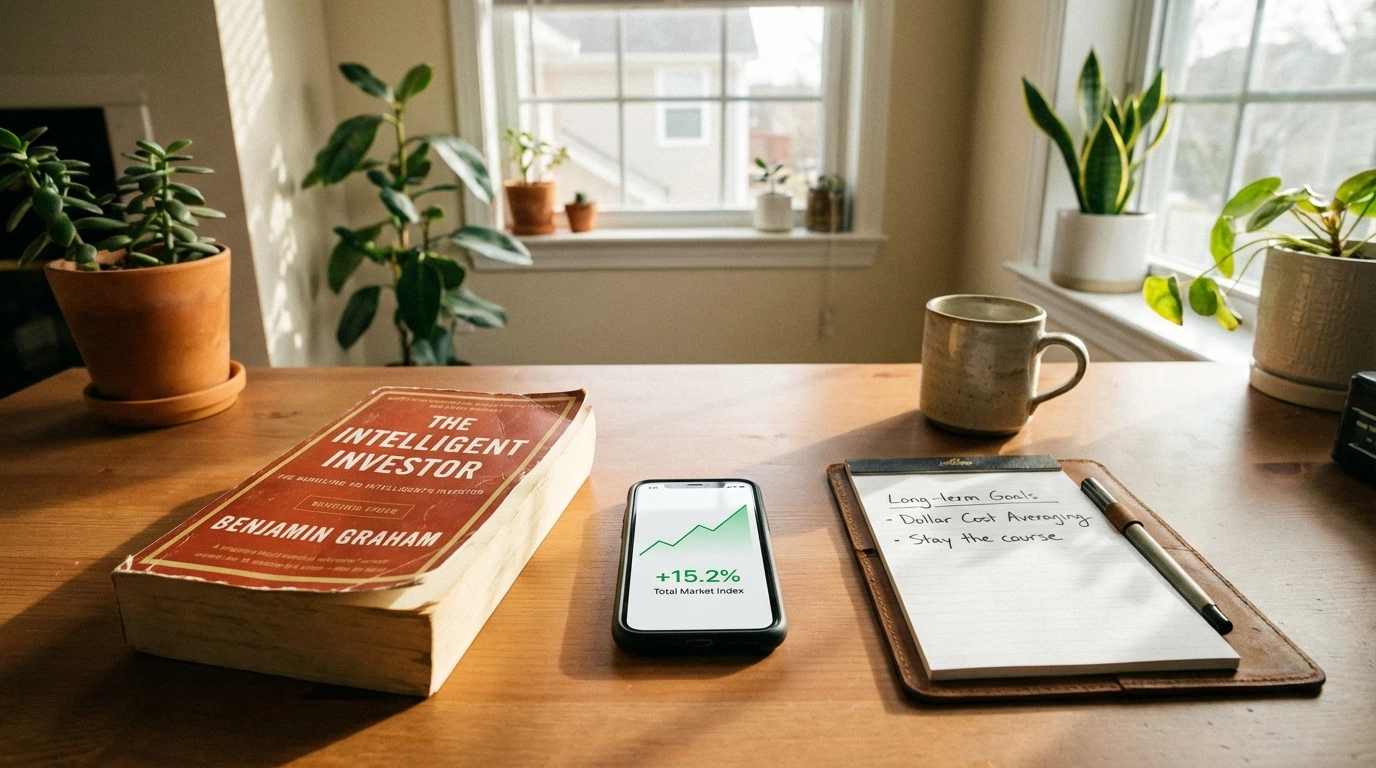
Dollar-cost averaging means investing a fixed amount on a regular schedule — say, $100 every month — regardless of market conditions. When prices are high, you buy fewer shares. When prices drop, your money buys more. Over time, this smooths out your average cost and removes the emotional burden of trying to time the market. It’s one of the most reliable strategies for long-term investors.
Keep Costs Low
Fees matter enormously over decades. An expense ratio of 1% versus 0.04% might seem trivial, but on a $100,000 portfolio over 30 years, the difference in final value can exceed $150,000. Always check expense ratios before investing and favor low-cost index funds and ETFs over high-fee actively managed funds.
Don’t Panic During Market Downturns
The market will drop — sometimes sharply. Crashes, corrections, and bear markets are a normal part of long-term investing. The worst thing a new investor can do is sell during a downturn and lock in losses. History shows that markets have recovered from every correction. Stay the course, keep contributing, and view downturns as an opportunity to buy more at lower prices.
Conclusion
Investing doesn’t have to be complicated or intimidating. With as little as $25 a month, you can open a brokerage account, buy a low-cost index fund, and start your wealth-building journey. The most important step is simply getting started. The longer you wait, the more compound growth you give up. Pick an account type, choose a reputable brokerage, automate your contributions, and let time do the heavy lifting. Your future self will thank you for every dollar you invest today.
Read more at https://en.icardin.com/
